Showing posts with label ICES. Show all posts

Thursday, August 13, 2015

Cover Your Cakes in Sugarveil!

This lace wasn't piped, it's molded!
     Have you ever been piping an elaborate lace design on a cake and thought "MY GOD! THERE MUST BE AN EASIER AND FASTER WAY TO DO THIS!"? Well, the good news is, that there is an easier way to do it, SUGARVEIL! Just what that heck is SugarVeil? Well, SugarVeil is a brand name for a product called "confectionary lace." There's also some other brands like "SugarDress" but from what I can tell, sugarveil arrived on the scene first. It starts as a dry mix, then you add liquid and mix it into sort of a goo. Once it's the right consistency (think, royal icingish) you can pipe it, spread it out or work it into thin silicon molds. You let it set up either at room temperature for a few hours or in a 200 degree oven for a few minutes and you have this magical product that peels away but stays flexible!! You can attach it to your cakes, smooth it over cupcakes or decorate cookies with it. It's totally edible and pretty tasty and it allows you to make a ton of perfect lace quickly.


  Have I peaked your interest? Let's get into the how-to. For my photos, you should be aware that I
am using "SugarDress." I have, however, recently switched over to working with SugarVeil and saw a lot of really great stuff from them at the ICES convention. In fact, the creator of the product was there to demonstrate how to use it! I'm not an expert on this stuff yet, but it's just so cool and fun to use that even as a novice it was really approachable and I would definitely recommend trying it! Both products work about the same way.
 
Magical White Powder...
No, not that white powder....
This is before icing it up.
   The first thing to do is follow the instructions that come with your product to mix it up to the proper consistency. SugarDress involves a powder and some sort of magic liquid goo, SugarVeil is just a powder that you mix with water. It's pretty straight forward and no more difficult than making a little bit of royal icing.

  SugarVeil has different suggestions for mixing based whether you are going to spread your sugarveil into a mold or pipe it out by hand. If you are going to pipe it, you will want a slightly stiffer consistency. If you are going to spread it into a mold, you will want a runnier consistency so that it will flow into all the nooks and crannies.

SugarDress, silicon mats and tools of the trade.
     If you are going to pipe the SugarVeil you can free-hand it onto a flat surface, which is pretty cool. It makes it a lot easier to pipe than trying to pipe directly on the side of a cake and you could follow a pattern really easily by piping onto transparent acetate over a template. You would then let your design set up completely. Next, and this is the really awesome part, you can peel it up off your acetate and directly apply it to your cake, cookie or cupcake! It's so cool! It's flexible, so it won't snap like royal icing could (but be careful because you can still rip it if you're not careful.) I just about lost my mind the first time I peeled it up! My husband and business partner, it should be noted was less excited than I was.

    If you are going to mold it, you can use one of the many silicone mats that are being made for this
The blue mats and all those packets on the left are my
SugarVeil haul from the ICES convention.
product. There are a ton of different patterns to emulate everything from lace to burlap, spiderwebs to steampunk gears. And, the mats all have a TON of detail. So much detail that it looks like you have real lace on your cake. The downside? The mats aren't cheap. The upside? Hopefully you will save so much on labor while making such gorgeous cakes that it will be worth it. Also, the designs are SO pretty. There are a quite a few brands on the market selling these mats, so shop around for a design you like. Also, some mats have just about a 14" length of design while some bigger mats have 3- 14" lengths. I would really recommend getting the bigger one, otherwise, if you have to cover a whole cake with lace you might get stuck repeating the process over and over again. That would sort of defeat the labor-saving appeal.


   Using the molds is pretty easy. You start with your pourable SugarVeil and you treat it sort of like you are going to grout some tiles. You pour it over your mold and then use an offset spatular or a rubber scraper to spread it over the entire mat. Then, you use a straight edge (like a rubber bowl scraper or on the stiffer scrapers that they sell specifically for this purpose) and you carefully scrape over the entire mat and remove all the excess SugarVeil  that hasn't been pushed into the mold. Once the surface of your mat is clear, you can allow it to dry at room temperature or you can dry it in a 200 degree oven for about 10-15 minutes. I would recommend adding a second coat at this point, then dry it a second time before trying to remove it from the mold.
Above you can see me applying the Sugarveil,
Spreading it out and removing the excess.
   
This how it looks after coming out of the oven.

    Now we're at the exciting part! Once your SugarVeil  is set and you can carefully peel up an edge,
you turn the entire mat over (so the SugarVeil is facedown) and carefully peel the mat away from the lace. This seems to work better than trying to peel the lace up out of the mat when it comes to preventing tears. Try to use an even hand (or your scraper) when peeling the mat away, and keep an eye on the extra delicate parts, they may need a little help out of the mold to prevent tearing.
I know, I'm pulling the sugarveil up exactly like I told you not to. But you might not be able to see it the other way!

    Now you've got some really awesome flexible confectionary lace and it's ready to go onto your cake! You've saved yourself hours of piping time! Your lace looks awesome! Just brush the back with piping gel (or maybe watered down royal icing) and attach it to your cake. You can cut away what you don't need with a pair of scissors of a craft knife. You can also paint your SugarVeil with an airbrush or by hand to add some pop.
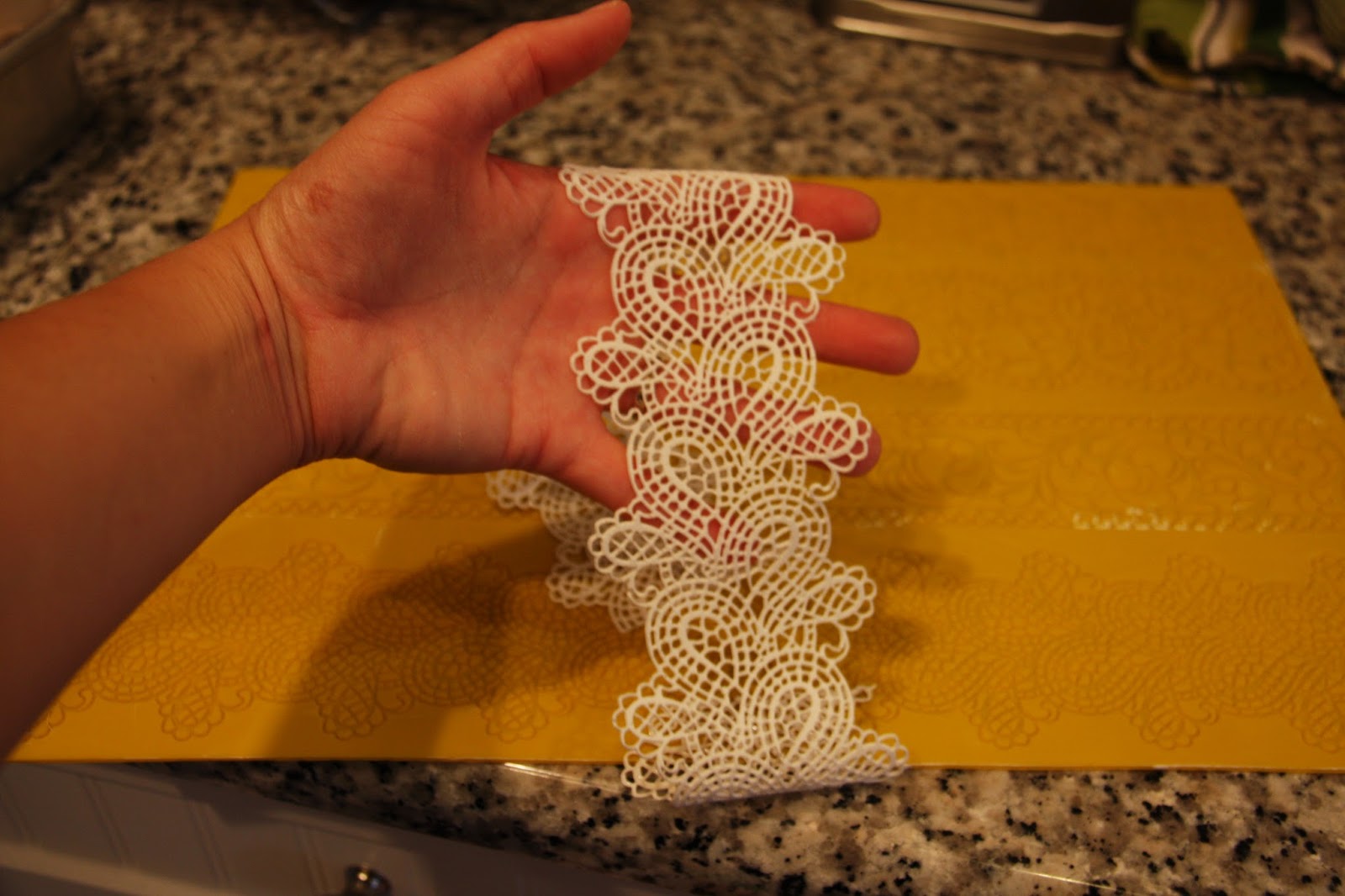
It's so flexible and delicate! Seriously,  SO cool.

    If you're not quite ready to put it on your cake, that's totally fine! Another awesome thing about SugarVeil is that you can roll it up, or gently fold it, put it in a plastic baggie and will stay good and flexible for a really long time! We're talking, months! OR you can let it set up hard, store it, then bring it back to life with a little steam or a moist paper towel. HOW COOL IS THAT!? You can get ahead on those wedding cake details for June (when it's crazy) in March (when it's slow)!

My secret shame, I didn't pipe this lace!!
   So, while I really love SugarVeil and I think it's super fun to play around with, I do feel a little www.sugarveil.com and see a bunch of photos of stuff they've made with the product. You can also check out SugarDress products at www.globalsugarart.com where there is also a ton of other decorating product. I don't want you to think I've been paid off by theSugarVeil people, I haven't, I'm not nearly that important!! I'm just really excited about this cool, and still fairly new, decorating product.
guilty when people compliment the lace and I know that wasn't really all that hard to make. That's the kind of person I am, I'm bad at taking a compliment. I will always be more impressed by a cake that is completely hand piped than one which uses molds, but that doesn't mean the cake is any lovelier. I don't think SugarVeil can or should replace all hand piping, but it is a super cool tool that belongs in any cake shop. It also invites creativity to use the SugarVeil  in ways that you can't use royal icing. When I saw their booth at ICES I basically bought everything because it was just SO cool. If you have the chance, check it out. You can buy it from their website
 
    If you are interested in having a beautiful lace cake, but aren't quite prepared to make it yourself, check out our website www.frostedfoxcakeshop.com and get in touch. We'd love to make a gorgeous cake for you, especially if you're interested in using some gorgeous confectionary lace as part of the design. If you enjoyed this, like us on Facebook too (www.facebook.com/frostedfoxcakeshop) and pass it on to your friends! Feel free to message us with any questions you have!

Thursday, August 6, 2015

Cake Conventions and Royal Icing!

   Sorry for the long delay between posts! We had a busy weekend at the ICES conventions in Omaha and we've been playing around with our new decorating toys ever since we got home. My intention is to continue with our little series on icings and talk about royal icing today. Luckily, royal icing and ICES go together like, well, cake and icing.
One of the award winning cakes at the ICES show! This cake traveled all the way from Sri Langka and it's covered with
delicate royal icing string work! Everything red on the cake is super fine piped royal icing.
Me and ICES Hall of Fame Winner Dominic Palazzo!
Bonus: this lady photobombed the crap out of us!
   What's ICES? Well, I'm glad you asked. ICES stands for the International Cake Exploration Society. It was founded 40 years ago and is made up of professional and hobby decorators as well as anyone else who is really interested in the sugar arts. My husband and I joined ICES this past year and this convention was the first time we attended one of the society's meetings. There were demonstrations, hands on classes, a cake competition and a pretty sweet vendor room. What's cool about the ICES show is that there are a lot of really wonderful, world-class, master sugar artists and cake decorators. There are a ton of great tools, supplies and techniques to explore while attending the show. It's a cool place to go to get inspired and to learn something new.

    Now, if I'm being completely honest, the convention wasn't exactly what I was expecting. It seems that membership may be slowing a little bit and attendance at the conventions has been down. My hope is that in future years it will peak again. Apparently Omaha was a little hard for some people to get to. But, we saw great demonstrations and met some great people. I'm already hoping to attend the next convention on the cake circuit (The America's Cake and Sugarcraft Fair) but it depends on whether or not the shop is open by the time the event takes place in Orlando. Also, for the record, we learned at the convention that ICES seems to be pronounced to rhyme with "Pisces."
The central cake is a great examples of many different uses of royal icing.
   So, how does royal icing tie in well with the ICES convention? Well, just about all of the classic decorating techniques utilize royal icing as their medium. Royal icing is basically an icing made of egg whites and confectioner's sugar. Sometimes people add meringue powder, lemon juice or cream of tartar. Sometimes I simply mix confectioner's sugar and water if I need to let the icing flow over a surface (imagine the top of a decorated cookie). You can adjust the consistency of royal icing depending on your desired application, sometimes it is better that it be stiff, and sometimes a more liquid icing is required.
This gorgeous cake has a ton of amazing royal icing piping, collars, brush embroidery and gumpaste flowers!
Note how the lattice work on the second and top tiers stand away form the cake!
   When do you use royal icing? You can ice an entire cake with royal icing if you like, although in the US most people don't ice their cakes with royal icing. It's more common to see it on British cakes where the cake itself is usually very dense fruit cake that doesn't need to be refrigerated. Royal icing will tend to set into a hard shell, so that's another reason why people in the US don't usually use it. I tend to think of royal icing as being a better fit for icing cookies, gingerbread houses or for additional decorating on top of the base layer of fondant or butter cream.

This rounded white mounds are made by
criss-crossing piped strands of royal icing to
 create the"cushion lattice" technique.
    There are many techniques for decorating a cake that require royal icing. String work is a type of decorating that requires the strength and setting ability of royal icing. Collars and color-flow use royal icing to make solid plaques of royal icing. You can also make "lace points" by piping royal icing onto acetate or parchment into pretty designs, then letting it set up stiff, removing it from the sheet and attaching it to the cake.

    Of course, you can also pipe many kinds of flowers with
The central rose on this cake is a
great example of brush embroidery.
royal icing. What's cool about piping flowers our of royal icing is that you can let them set up hard and then apply them to your cake in really cool ways. Once they are set you can paint details onto them as well! Another technique that I love which uses royal icing is called "brush embroidery." With this technique, you pipe a thick outline of royal icing then, before it sets, you use a damp brush to pull the icing towards the center of the design to emulate the look of embroidery. In fact, I used brush embroidery on my wedding cakes!
I made these "UP" themed cookies for
a friend's baby shower. The cookies are iced
with royal icing.

   Another use for royal icing is to decorate cookies. You've probably seen cookies iced with royal icing in countless magazines and pinterest photos. You can either pipe an outline of color with the royal, then fill it in with a thinned out version, or you can dip the flat surface of the cookie into the icing and let that make a thin layer to cover the cookie. Once you've applied this first layer, if you work quickly you can pipe details in that will smooth out flush with the surface, drag a pin through to make designs or add sprinkles and attach other details. If you let the surface set you can pipe on additional details that will sit above the first layer to add depth and texture to your design.

    In our shop we don't use royal icing too often. We do use it decorate cookies, but we will usually use butter cream or fondant for most of our cake and cupcake decorations. While string work, color flow and collars are really cool, they are very traditional and don't seem to appeal to the modern American bride as much as they used to. Now, it's totally possible that they will come back into vogue if ornate cakes cycle back into popularity. In the meantime, it's really important to have those skills in your repertoire so that you can play around with interesting ways to use them. The applications for royal icing are pretty endless, but be aware it can be susceptible to moisture and humidity. Next time, I'll talk about a newer product called "Sugarveil" which is being used to emulate some of the affects you can get from royal icing.